Valueless CTO: High Salary, No Return
Two weeks ago I sat through a board call with a seed-stage startup. Burn rate north of “I’d rather not say,” roadmap slipping quarter after quarter, and everyone kept skirting around the awkward topic — their CTO was basically a spectator. He nodded, approved budgets, cracked a joke or two, and that was it. No technical direction, no probing questions, zero pushback on obviously risky deadlines. Just a very expensive Zoom tile.
I wish this was a one-off. Over the past decade I’ve watched more than a handful of companies carry a CTO on payroll who delivered little beyond a fancy title. (I could be wrong, but it feels like the title started getting handed out the moment VC money appeared — “we have engineers, therefore we need a CTO.”)
So where’s the line between “strategic tech leader” and “well-paid mascot”? I kept scribbling notes after that call and, eventually, grouped the failure modes I see most often into four buckets. They aren’t mutually exclusive — sometimes you get a combo pack — but each is missing one crucial piece of value:
- Non-technical CTO — missing expertise
- Invisible / Absent CTO — missing role-modeling
- Misaligned CTO — missing shared goal
- Asshole CTO — missing people skills
Strip any one of those qualities from an otherwise decent leader and the company starts wobbling. Sometimes it takes months to notice, sometimes years — enterprise inertia can mask a lot — but the wobble is there.
✅ My rule of thumb: a CTO is valuable only when all four boxes are checked at the same time. Miss one and the slope turns slippery.
You might point at a profitable startup that’s still humming along with a less-than-stellar tech lead. Sure, it happens. But in every case I’ve seen up close, they’re succeeding despite the CTO, not thanks to them. Give the team a proper leader and things usually accelerate — or at least stop catching fire at 3 AM.
Smaller orgs feel the pain faster. When your entire engineering department fits into one Slack channel, an underperforming CTO can’t hide behind process or middle management. Bigger companies can paper over the gaps with directors, staff engineers, and endless steering committees (I’m still not convinced that scales indefinitely, but it buys time).
If you happen to carry the three letters on your LinkedIn — or you’re thinking about hiring someone who will — the following pitfalls are worth double-checking.
Non-Technical CTO
This one still baffles me. Early-stage company, deeply technical product, and the person in charge of technology can’t explain how the system works without resorting to buzzwords. Fortune 500s sometimes get away with a purely managerial “CTO” (whole other debate), but a startup? That’s like hiring a pilot who’s great with investors yet has never landed a plane.
I’ve sat in investor meetings where the CTO defaulted to the same talking points the CEO had just delivered. No extra depth, no risk analysis, no alternatives offered. The board smiled politely; the engineering team cringed later on Slack.
Respect is another casualty. Engineers will give you the benefit of the doubt for a sprint or two, but once they realize leadership can’t parse even surface-level architectural diagrams, motivation tanks. (Been there, tried patching it with “communication workshops,” watched it flop.)
Worse, tech decisions start drifting toward whichever vendor has the flashiest demo. I recall a hypothetical example where a startup glued their entire data pipeline to a single third-party service because the landing page touted “AI-powered scalability.” Twelve months later the provider folded and the company spent a quarter rewriting critical paths. Could a technical CTO have foreseen the risk? Probably. At the very least they’d have asked uncomfortable questions before signing the PO.
✅ If your company is smaller than, say, a small company, make sure the CTO can still draw architecture on a whiteboard and defend it under cross-examination.
Leadership and vision matter, yes, but without the technical layer you’re basically appointing a second CEO. That’s rarely what the company is missing.
My admittedly biased advice: pick someone who can debate stack choices today and spot emerging tech tomorrow. MBA optional, curiosity mandatory.
Invisible / Absent CTO
Once your engineering org crosses a couple of hundred people, the CTO naturally spends more time with finance, legal, and external partners. Fair. Under that threshold, disappearing from day-to-day life is a red flag.
The pattern is easy to spot: recurring 1-on-1s keep getting rescheduled, demos are skipped, praise is non-existent, decisions arrive via forwarded emails at 22:00. The team starts guessing priorities, and sooner or later they guess incorrectly.

Good engineers don’t need daily hand-holding, but they do notice when leadership goes radio-silent. Culture follows suit: when the boss is always late, meetings start sliding; when the boss never gives feedback, peer reviews dry up. It’s a trust battery that quietly discharges.
Compare that with a CTO who still pops into stand-ups, asks a clarifying question, or even pair-programs once in a blue moon. Visibility beats heroics every time. I’m not suggesting you rewrite every pull request — you have your own problems to solve — but showing up signals that the work matters.
✅ Every healthy startup I’ve advised had an engaged CTO. Correlation isn’t causation, but the pattern keeps repeating.
If you’re leading from afar, do a quick pulse check: when was the last time you attended a demo unannounced, or wrote a design doc comment longer than “LGTM”? If the answer makes you uncomfortable, the team probably feels it too.
Misaligned CTO
Disagreements with the CEO are healthy — I’d be worried if you never argue. But once you start wanting fundamentally different outcomes, you have a problem no OKR can fix.
I run our agency with two partners, and we’ve had our share of stubborn debates. What keeps it civil is a simple rule: majority wins, minority commits. If a decision still feels wrong after sleeping on it, we revisit, but we don’t sabotage in the meantime.
When a CTO loses faith and continues half-heartedly anyway, the rot spreads. Roadmaps get “re-prioritized,” teams receive mixed messages, architecture drifts toward whatever aligns with the CTO’s private agenda. I’ve witnessed a whole platform rewrite kicked off purely because the tech lead disliked the original founder’s language choice — productivity cratered for a year.
✅ The moment you can’t champion the company’s vision in front of your engineers, you either realign or resign. Anything in between is poison.
The choice often boils down to two paths:
- Adopt the CEO’s viewpoint long enough to see if it holds water.
- Step aside before your doubt turns contagious.
If you stay, over-communicate. Drag assumptions into the light, document trade-offs, invite pushback. That transparency is the only antidote I know for misalignment.
Asshole CTO
I tried labeling this “interpersonally challenged,” but let’s call a spade a spade: brilliant jerk syndrome. Code wizardry combined with zero empathy.
Hacker News is full of war stories about toxic technical founders. The headlines usually mention the genius, rarely the churn rate. High EQ isn’t “nice to have”; it’s the multiplier on all the other skills.
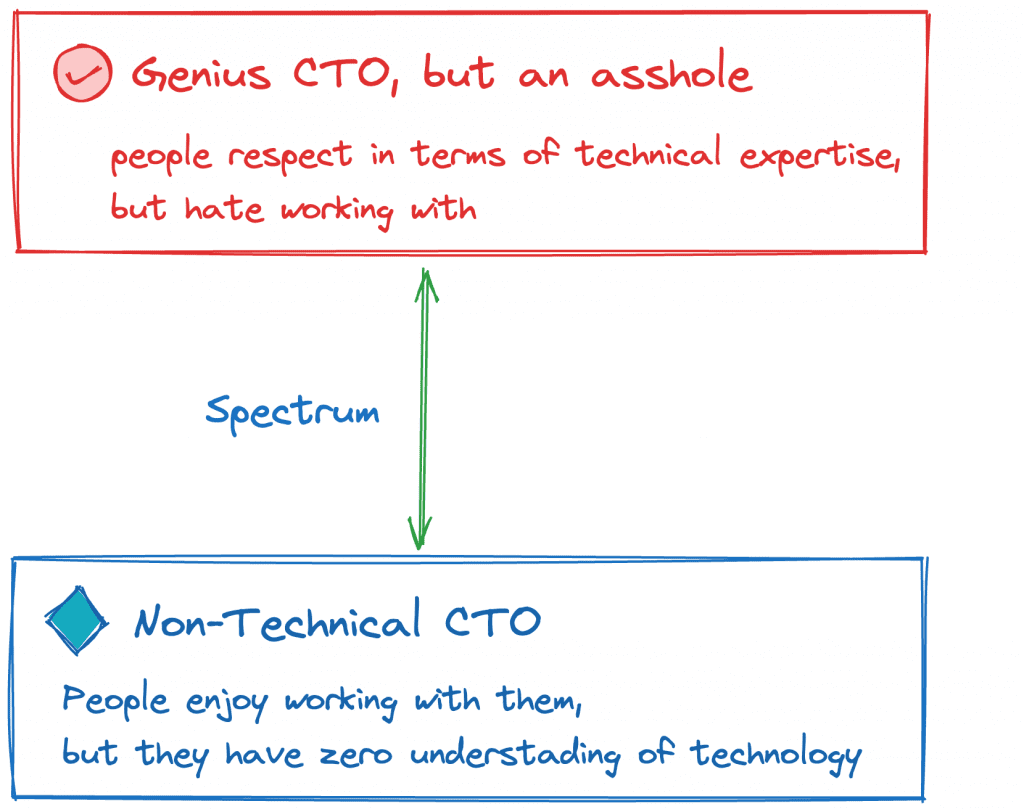
You can ship v1 alone, maybe even v2, but eventually sickness, vacations, and plain bandwidth limits catch up. Teams scale, solo heroes don’t. And top talent rarely sticks around to be belittled on every code review.
✅ High performers look for psychological safety first, tech stack second. Lose the former and the latter won’t save you.
The role of CTO evolves into coach far quicker than most tech founders expect. If mentoring, clear communication, and the occasional apology feel beneath you, hire a VP Eng who enjoys that part and give them real authority. Otherwise your retention graph will resemble a ski slope.
Strive for the middle ground: enough technical depth to guide architecture, enough humility to elevate others. Anything else is vanity.
Conclusion
CTO is one of those roles that looks absurdly simple on an org chart yet touches almost everything once you pop the hood. Miss the technical chops, the visibility, the alignment, or the human decency, and the value equation flips from asset to liability in a hurry.
Uncomfortable question to leave you with: if we ran an anonymous survey inside your company tomorrow, would your name come up as force-multiplier or as cost center? Worth pondering before the next compensation review.
Other Newsletter Issues:
Worried your codebase might be full of AI slop?
I've been reviewing code for 15 years. Let me take a look at yours and tell you honestly what's built to last and what isn't.
Learn about the AI Audit →No-Bullshit CTO Guide
268 pages of practical advice for CTOs and tech leads. Everything I know about building teams, scaling technology, and being a good technical founder — compiled into a printable PDF.
Get the guide →
1 Comment
Such an important topic but delivered in such a negative, accusatory tone that makes it hard to read and take learnings … Here is a more positive statement.
—
The High Impact CTO
A successful Chief Technology Officer (CTO) can significantly elevate a company by embodying essential qualities and skills. Effective CTOs are not only technical experts but also visible leaders who inspire their teams. They align closely with company goals, ensuring technology strategies support business objectives. Furthermore, they possess strong people skills, fostering a positive work environment. By being technically proficient, present, aligned, and empathetic, CTOs can drive innovation and growth, proving their worth and delivering exceptional value to their organizations.