Falsehoods Junior Developers believe about becoming Senior
Back when my Linked In still said “Junior Rails Dev (contract)” I had a very cinematic idea of what “Senior” looked like. Picture Neo in Matrix Reloaded, except with a mechanical keyboard. They typed, bugs evaporated, meetings parted like the Red Sea. I know now that a lot of that aura comes from title inflation—companies hand out “Senior” after two years to reduce churn—so the badge alone tells you almost nothing about the actual job.
Still, the myth persisted for me until one particular afternoon: I’d broken the fstab on my Arch install (this was 2013, I think; systemd had just landed and everyone was angry). I pinged the most intimidating engineer in the office. He squinted at the terminal, muttered “I have no clue what’s going on here,” and then started googling in front of me. That five-second admission did more for my career than any conference talk—apparently seniors are just people who are comfortable saying “no idea, give me a minute.”
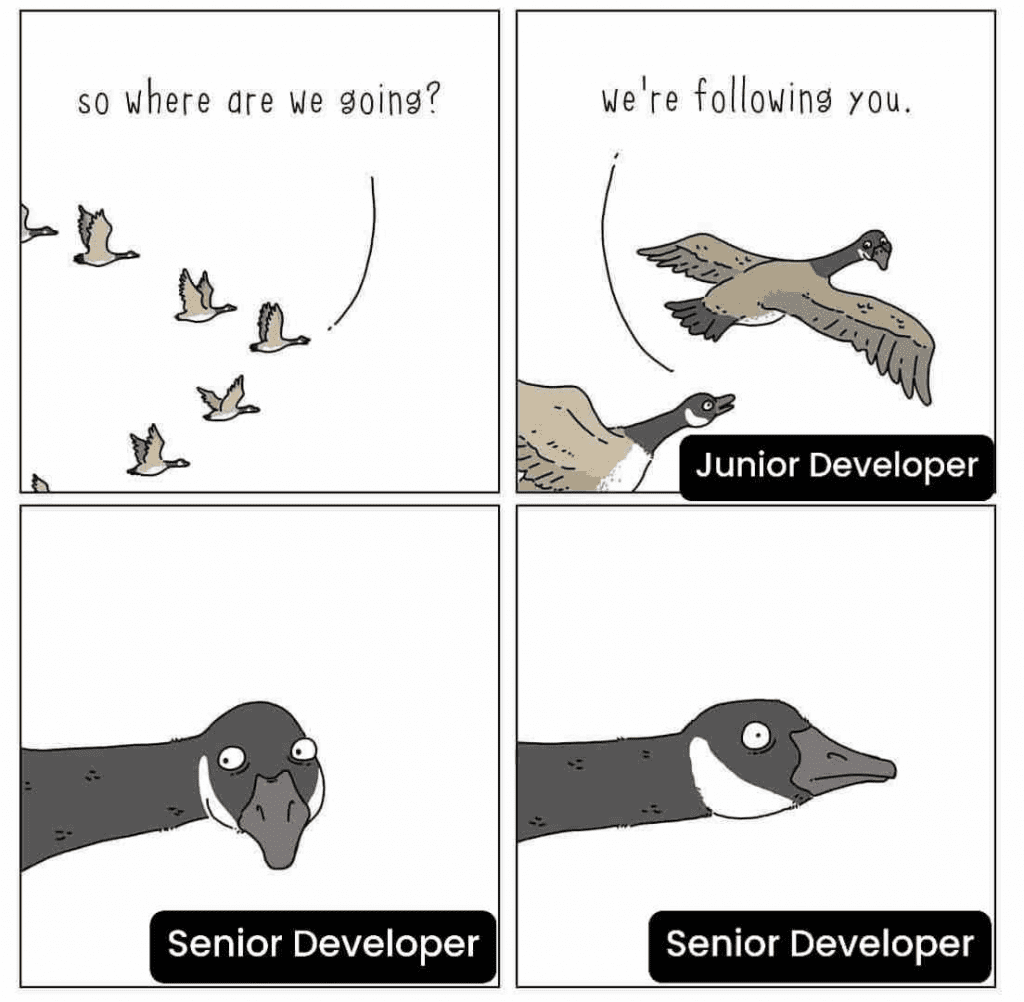
So, if you’re expecting a promotion to grant you omniscience and a cloak of authority—keep reading. I might ruin the fantasy, but (in my experience) the reality is messier and far more interesting.
Having all the answers
❌ Expectation: I will fix every bug in minutes.
✅ Reality: “No clue yet—give me 30 and a strong coffee.”
The catalogue of things I don’t know grows faster than the GitHub trending page. New LLM wrappers, five JavaScript meta-frameworks per quarter, some fancy CRDT library I’ll never touch—it’s endless. I could be wrong, but I’m pretty sure seniority is less knowledge accumulation and more “knowing how to navigate the fog.”
What actually gets measured (at least on teams that know what they’re doing):
- Ability to stay calm when half the dashboard is red (panic is contagious).
- Knowing which questions collapse the search space fastest.
- Having a personal library of debugging tactics, Google-fu, and people you can DM for esoteric edge cases.
(Side note: I still say “I have no idea” at least once a day. The trick is to follow it with “here’s how I’ll find out.”)
Working with latest tech
❌ Expectation: My days will be 100 % Rust + WASM + AI agents.
✅ Reality: grep’ing through a ten-year-old PHP monolith—voluntarily, sometimes.
Legacy code has a bad PR team. Yes, comments are scarce and the build script requires an ancient version of Yarn that only runs on macOS Catalina. But the upside: the ghosts are mostly documented in commit history, and every refactor ships real value because customers rely on that mess. Greenfield projects, by contrast, feel like playing Minesweeper on expert mode—unknown unknowns everywhere.
I could be wrong but a significant portion of the market runs on tech older than TikTok. Seniors who can patch, stabilize, and gradually modernise those systems become the de-facto heroes (even if nobody claps). The flashy new stack might land you conference slots; keeping billing online at 3 AM keeps the company alive. Pick your dopamine source.
No more boring tasks
❌ Expectation: Senior = only the fun tickets.
✅ Reality: Syncs, docs, reviews—plus the fun tickets.
Meetings, documentation, code reviews—classic villains. They also happen to be the cheapest way to prevent production fires. After botching two rollouts because “nobody wrote down the Envoy config,” I started treating docs like tests: boring until the day they save you. Same with meetings. Half are pointless, sure, but the other half delete entire classes of misunderstanding.
Worth noting: seniority doesn’t automatically chain you to a laptop at 6 PM on Friday. Mature teams build real on-call rotations, write runbooks, and respect off-hours. I’ve seen engineers climb the ladder and protect their evenings—turns out focus between 9 and 5 beats heroics at midnight.
Enjoyed the read? Join a growing community of more than 2,500 (🤯) future CTOs.
Embrace the “boring” work where it matters, and push back on busywork where it doesn’t. That tension never fully disappears.
Making big changes
❌ Expectation: I’ll rewrite the platform in three sprints.
✅ Reality: Budget, politics, risk models—pick two.
Early in my career I’d drop into a new repo and instantly draft a migration plan to “something cleaner.” Management nodded politely and ignored me. I spent months annoyed—until I saw the quarterly P&L. Retaining customers beat code elegance every time. These days I pitch ideas like an accountant: cost, risk, upside, fallback plan. Romantic? No. Effective? Mostly.
(I should be upfront—this works for companies with some process. In a five-person startup the calculus is different; you might still get away with the big rewrite.)
Time to relax
❌ Expectation: Senior title = hammock time.
✅ Reality: Autonomy, yes. Automatic free time, no.
Your calendar stops being managed by someone else and starts being managed by you. That sounds like freedom until you realise every gap is an invitation: mentoring session here, architecture review there, a quick PR because the junior is blocked. Some seniors embrace weekend sprints; others slam the laptop shut at 17:01. Both patterns exist, and careers grow in both. The difference is boundary management, not raw hours.
If you want longevity, practice saying, “That can wait until Monday.” The code will still be there, promise.
Deciding what to do
❌ Expectation: I’ll hand out tickets like a benevolent dictator.
✅ Reality: I spend half a day figuring out which fires matter.
The higher you climb, the fuzzier the tasks. One minute you’re tweaking a SQL index, the next you’re mapping HR workflows to an “AI strategy” somebody promised at a board meeting. Nobody writes detailed specs for that. You get fragments, contradictions, and a deadline. Somehow you must turn that into a roadmap and working code.
It’s exhilarating and mildly terrifying. I miss the days a team lead slid a Jira ticket across my desk and said, “Just make the tests pass.” But I wouldn’t go back.
Becoming irreplaceable
❌ Expectation: Deep system knowledge = layoff immunity.
✅ Reality: Market cycles don’t read résumés.
I’ve watched whole teams vanish after a strategic pivot—legacy experts, principal architects, everyone. The lesson: job security lives in adaptability, not in being the sole keeper of a creaky codebase. Keep an eye on where the industry drifts, skill-up just enough to stay conversational, and maintain a network outside your current bubble. None of that is a guarantee, but it tilts the odds.
Being “the COBOL person” might pay well today. It’s less helpful when the company sunsets the mainframe next quarter.
UPDATE 18 March 2024: If you prefer video, I rambled about all this on YouTube. Here’s the link.
That’s my list. Drop more myths in the comments—there are plenty I’ve missed.
Other Newsletter Issues:
Worried your codebase might be full of AI slop?
I've been reviewing code for 15 years. Let me take a look at yours and tell you honestly what's built to last and what isn't.
Learn about the AI Audit →No-Bullshit CTO Guide
268 pages of practical advice for CTOs and tech leads. Everything I know about building teams, scaling technology, and being a good technical founder — compiled into a printable PDF.
Get the guide →
28 Comments
Great writeup!
Wow, just wow.
This really put things into perspective for me, even though I’m technically not a junior software developer anymore.
I believed most of these myths until I read through this article, and I feel like I know have a better understanding of what actually goes on in reality.
My only hope is that one day when I reach the senior position that I have a better control over my life and the confidence to know when it’s time to move on to a different role, and not get too attached to any piece of work.
Thanks for the truly insightful article.
Just a note on the Harry Potter meme – is there a reason the women in the image are “HR Head” and “Projector Lady” or am I to take it that it’s pure coincidence that none of them are in eng?
I too was bothered by the meme, so you weren’t the only one
No worries, removed the meme. Hope you still had fun reading the article.
Nice writeup! Managing legacy code is such a big thing and never really gets a proper treatment at universities or in general.
Great article! So much of this resonated with me as a senior developer. I will be reading more of your content!
On point, thanks!
In my company, every single HR position is held by women.
I think you may be getting offended based on a harmless meme.
I know right? In my company all the HR reps happen to be women too and… so is our CEO and many of our VPs and Execs. People are out here just looking to be offended smh.
The table of contents is a bit broken. The last five links don’t work.
Thanks, fixed that
Did you climb into my brain to write this? 😀
This article is spot on!
Good article! Accurate, relevant, and well-written, which is an anomaly in the world of software engineer. Kudos.
I agree. Not sure how I got here, was scrolling through my feed and this article popped up but am so grateful that I did. I do not work in this industry but in my line of work we are labeled as Junior and Senior. Funny I am also a “Junior” and will be training to be a “Senior” in about a week. Kind of nervous about it, though 😬. Anyways, your words meant a lot to me. Everything pin pointed to the type of changes that I will be expecting, which tbh was afraid of but after reading this what I feared came clear in reading this. Thank you for showing me a better understanding. Because of you I feel more confident in the transition of Junior to senior.
Learning to say “I don’t know” and using it as a springboard to dive deeper into problems has been the most liberating aspect of my progression in tech. The real skill comes from figuring stuff out on the fly, not from knowing everything upfront.
Agree with most. Great writing.
I don’t necessarily agree with the “I’ll finish this on Saturday” approach. In Europe we’re pushing more and more towards a healthy workload regardless of your seniority. Yes there are exceptions but overall it sounds more like an Americanism.
🙂
Try to work in Spain, you sign 40 hour/week but have to work 60 hour/week free.
Nowadays a junior developer struggling with a problem can ask AI to find a solution. So soon senior developers will become obsolete 🙂
Then easily become senior oh wait…
Agreed. As a senior consultant, I have mentored many junior developers of the companies that hired me and usually, within a year or so, they were sovereign enough to implement Jira stories on their own, respecting good coding practices, architectural patterns, tests, etc. Seeing such results make me happy, but the bad side of this is, that once the project was done, I wasn’t needed anymore. At least not as an engineer. I was simply too expensive. This doesn’t apply to every project of course ,especially if the project is continuously evolving. But many projects are not, they were ordered by a customer / market participant and once delivered, nothing will happen for quite a while
Could you mentor me please?
Dam! This is spot on!
Honestly, climbing from junior to senior was less about coding and more about mastering soft skills. I found that being able to communicate effectively, manage my time, and work well in a team made the biggest difference. Dealing with bigger problems and more responsibility was tough, but learning to lean on my team and ask the right questions helped a lot.
> Companies face various pressures […]. Drastic times call for drastic measures, a.k.a “investors are expecting higher margins”.
That is itself an external pressure. And it’s one that we cannot sustain, it’s a problem that needs to be solved.
We need business that can simply provide good service to customers, without investors unreasonable expectation of “higher returns”. A system that rewards business which stays in business, instead of the chaos of huge unreasonable expectation followed by mass layoffs.
Cool article
Do you think that Seniors always have an opportunity to find work because if the market is not good they can lower their salary and offer more knowledge and that will bring the opportunity to them, is that right ?