Contracts you should never sign
I still remember sitting in a hostel at 2 a.m., job offer in one hand, fountain pen in the other, trying to figure out whether “territory” in the fine print meant the EU or, somehow, planet Earth. That was the night I realised contracts aren’t paperwork — they’re code that runs your career. Since then I’ve treated every clause like a pull-request that can brick production if merged carelessly.
Quick legal caveat: I build software, not case law. What follows is experience, not gospel.
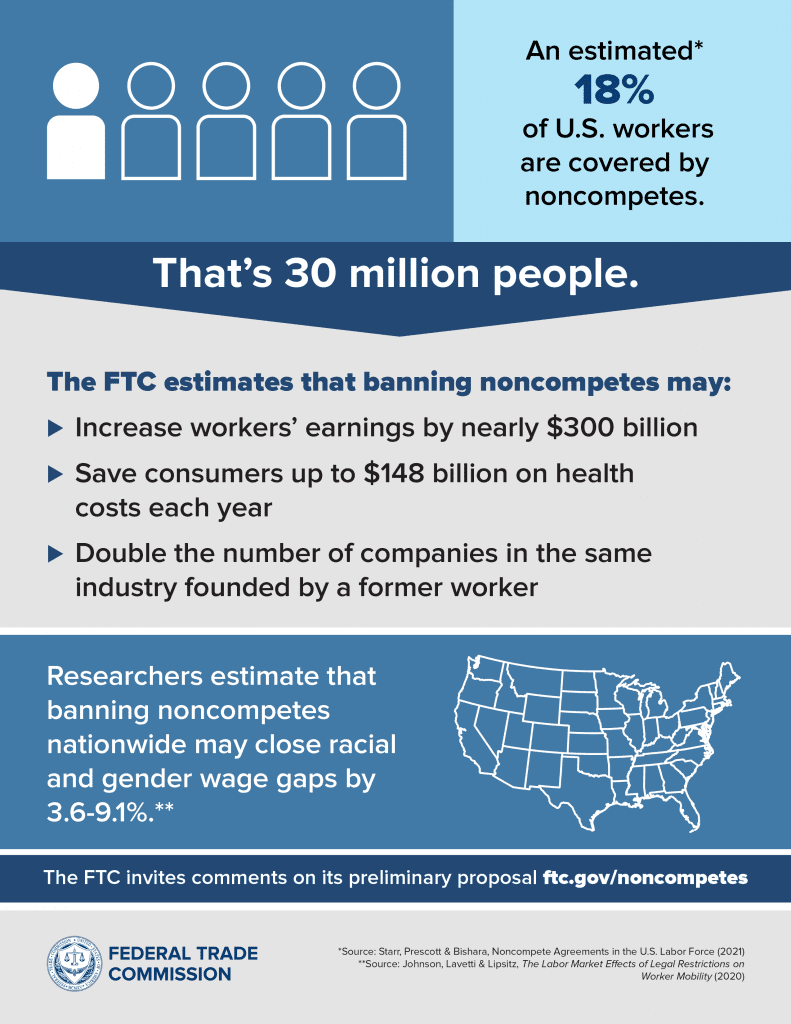
Joel Spolsky planted the seed years ago with his rant about NDAs. He called out the silliness early, and 2023’s FTC proposal to ban non-competes tells me the problem never really went away.
You need to keep your employees loyal by treating them well, not by creating arbitrary obstacles in their career.
Joel Spolsky
I keep bumping into engineers who skim agreements the way we skim cookie banners — click, click, whatever. The tweet below captures that misplaced optimism perfectly.
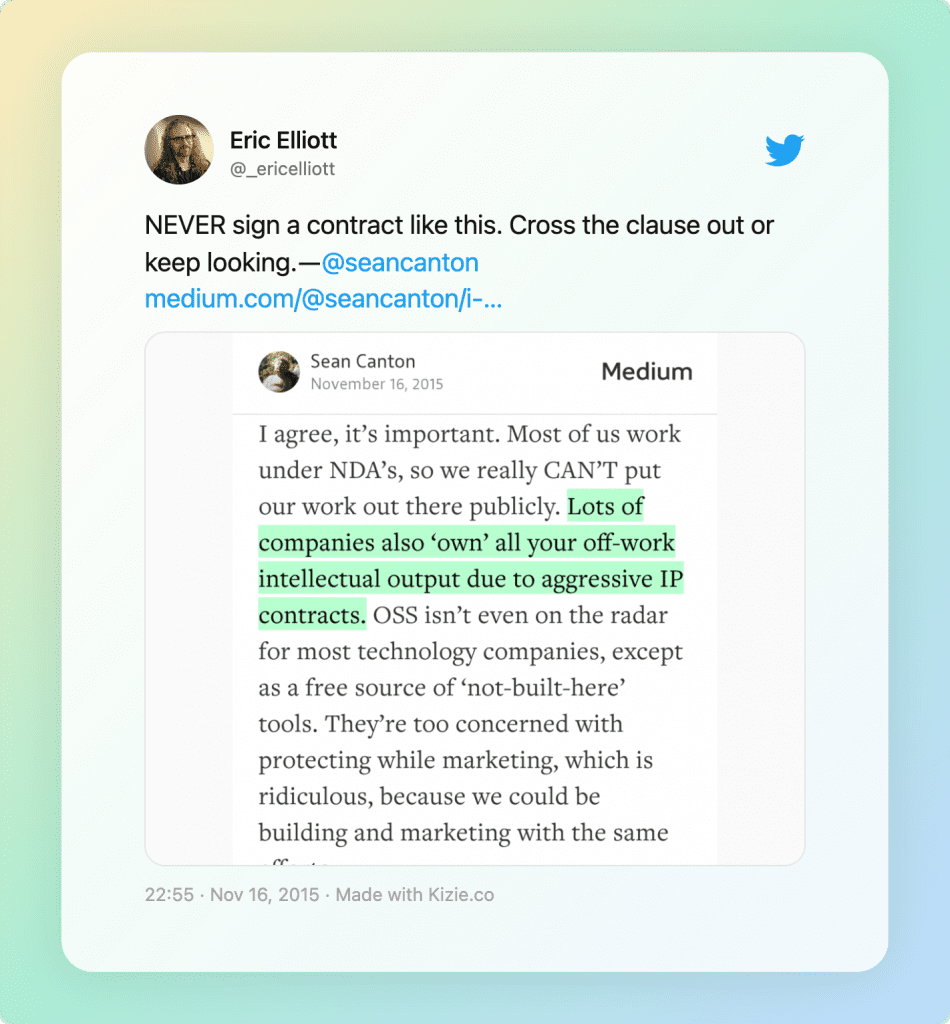
I’m generally a trust-first person, but contracts are where I switch to trust-but-compile-with-warnings. Ask dumb questions, mark unclear bits, push for edits. It’s bilateral — if something blows up later, “I assumed good faith” won’t save you.
And yes, contracts can move. Until the ink dries (sometimes even after), redlines are just pull requests waiting for approval. I’ve seen founders cave on scary clauses the moment someone called them out — they were testing the waters more than defending a principle. (I’m not entirely sure this scales to Fortune 500 legal departments, but it works in startup land.)
Stuff you shouldn't sign
Non-compete clauses. Full stop. They read something like:
Employee agrees, for a period of X months after resignation, not to work in the field of Y and/or within Z km.
I once saw “Z = 300 km around HQ.” That covered three countries and most of the industry conferences I attend. Crazy, yes, but also enforceable in some jurisdictions if you sign. Better IP protection tools exist — NDAs, invention assignments, plain old goodwill. Non-competes just broadcast insecurity.
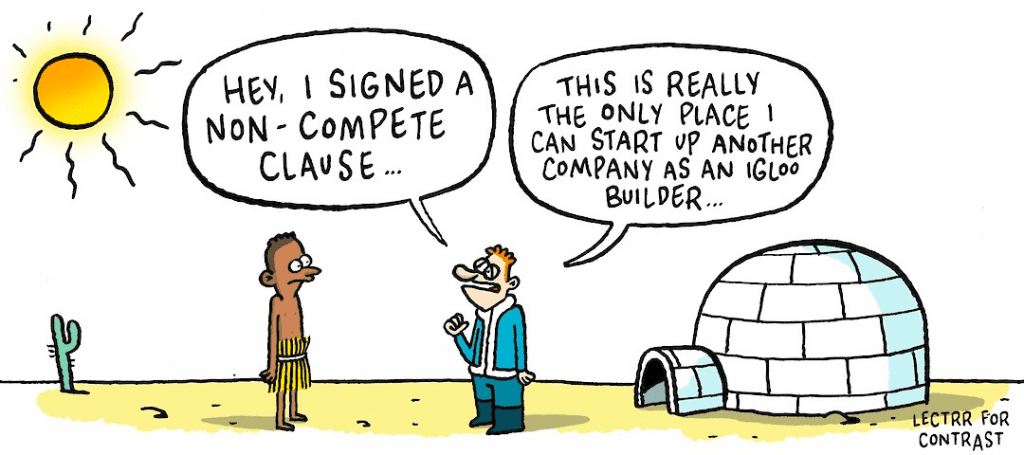
Market still favours competent developers, layoffs or not, so rejecting a non-compete isn’t career suicide. Worst case you walk — that’s cheaper than six months on the bench because legal’s breathing down your neck.
Sibling of the non-compete is the “no poaching” clause (“don’t hire our people after you leave”). Less toxic but still lopsided. I’ve only accepted it once, with a carve-out saying referrals are fine if the candidate applies of their own accord. Tiny tweak, huge difference.
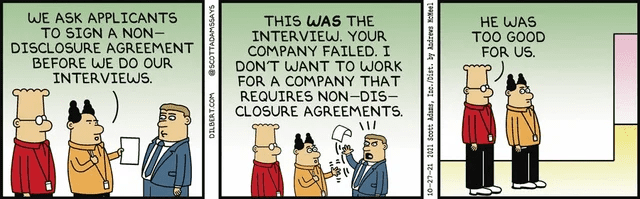
Over-broad NDAs. I probably sign two NDAs a month. Half of them try to label yesterday’s weather forecast as confidential. Reject blanket language, ask for an expiry date (four years feels sane), and pin down jurisdiction. Without those, you’re volunteering for indefinite silence.
One clause I keep flagging: “You may not hire our employees for two years.” That’s paranoia, not protection.
- Joel Spolsky
If the counter-party can’t define what’s actually secret, odds are nothing is — they’re just photocopying boilerplate. (I could be wrong, but the pattern hasn’t failed me yet.)
Exclusive distribution deals. Great if someone pays you Taylor Swift money upfront. Otherwise you’re locking future-you into one channel because present-you wanted a quick dopamine hit. I learned this the hard way with a tutorial series that could’ve lived on three platforms but got stuck on one for 24 months. Revenue: meh.
Project contracts without a scoped “definition of done.” Writing “Build an e-commerce shop” is like committing to “Make the app faster.” Faster than what? Shop with which integrations? Ambiguity equals scope creep equals 3 a.m. Slack pings. Spell out features, timelines, and acceptance tests.
💣 Any work contract should be explicit, never implicit.
I’ve yet to meet the client who resists clarity — they usually thank you for forcing the conversation. (This is what worked for us; no idea if it generalises to enterprise procurement departments.)
Clauses that you should avoid
Work-for-hire catch-alls. Sounds harmless until you prototype a weekend SaaS on the company MacBook and legal claims the whole thing. Three common pitfalls:
- Anything created on company hardware = theirs, regardless of context.
- Anything related to company business = theirs, even if built on your personal machine.
- Ownership isn’t just IP; it’s revenue streams and the mailing list you lovingly grew.
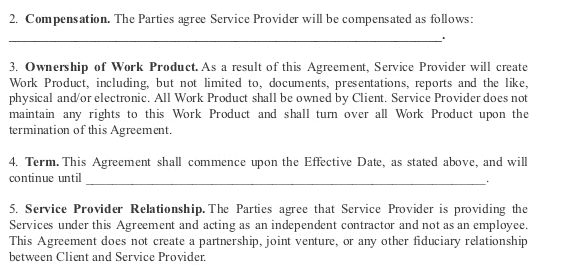
If you’re bootstrapping a side project, secure written exemptions before launch day. Most employers are fine once they see it doesn’t compete — but get that in ink, not Slack.
One-sided termination rights. Any clause that lets the other party bail “for any reason” while you’re chained to notice periods is asymmetric nonsense. Ask for symmetry or, at minimum, objective exit conditions.
Vague compensation language. The Facebook-Eduardo example is Hollywood-ified but captures the danger: dilution without clarity. Watch for missing vesting schedules, absent termination protection, and the lack of tag-along / drag-along rights.
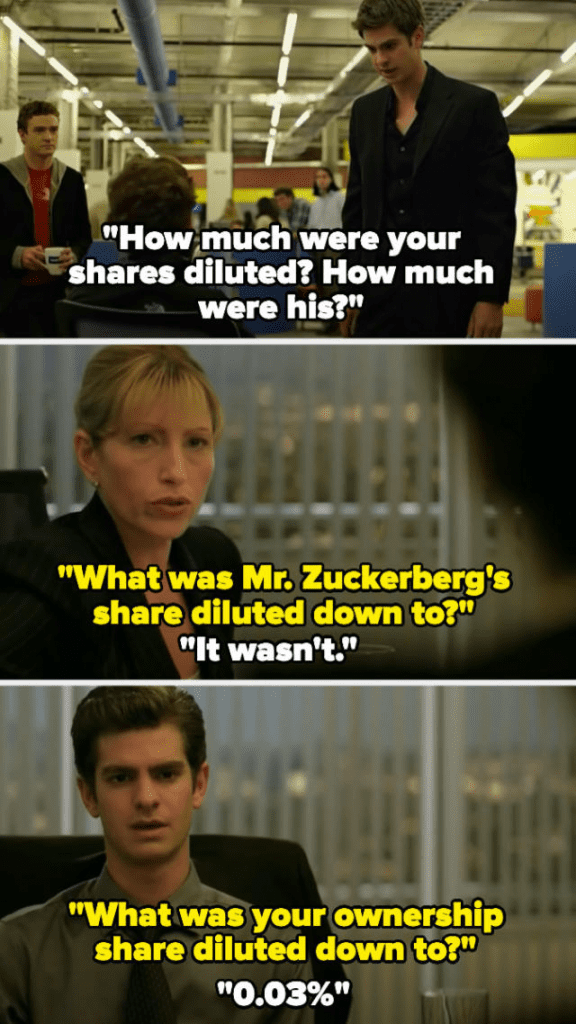
Red flags to tick off:
- No vesting period. Immediate ownership sounds great until someone quits month-two and keeps the same slice you toiled four years for.
- Missing termination logic. If the CEO can axe you without cause but your shares evaporate when that happens, run.
- No tag-along / drag-along. Without them you’re either stuck holding illiquid paper or forced to sell on unfavourable terms. Neither scenario is fun.
Automatic renewals. Signature today, calendar reminder five minutes from now — otherwise that gym-style contract rolls into another year. Not inherently evil, just designed for forgetfulness.
🚷 Never sign anything you're not completely sure about.
TL;DR;
Boiling the above down:
- Read the contract — or have someone pedantic do it while you make coffee.
- Everything is negotiable until you decide it isn’t.
- If the balance isn’t win-win, walk. There are other gigs.
- Gym contracts remain undefeated in the “impossible to cancel” league.
Got horror stories or loophole hacks? Drop them in the comments — the collective brain is smarter than any single lawyer.
Enjoyed the read? Join a growing community of more than 2,500 (🤯) future CTOs.
Other Newsletter Issues:
- Things they didn’t teach you about Software Engineering
- ⛓ Implementing Atomic Habits in IT
- Software Development is very subjective
Other Popular Articles:
Worried your codebase might be full of AI slop?
I've been reviewing code for 15 years. Let me take a look at yours and tell you honestly what's built to last and what isn't.
Learn about the AI Audit →No-Bullshit CTO Guide
268 pages of practical advice for CTOs and tech leads. Everything I know about building teams, scaling technology, and being a good technical founder — compiled into a printable PDF.
Get the guide →
20 Comments
You might be willing to accept a non-compete if it is associated with large enough severance package. (For example, if they are willing to give you one month’s salary for every month of non-compete, then it seems like an alright deal. I would make sure that the severance pay required for the non-compete to be in effect even if you are fired for cause.)
In some places these IP agreements are not legal, so they’ve attempted to work around those limitations by using Inventions Agreements.
Also, some people don’t realize this, but the name the other party puts on the agreement is irrespective of the content of the agreement.
Part of reviewing the agreement is breaking down the elements, and determining the type of agreement. Its annoying as this is a lot of work and this company behavior only limits the labor pool which ends up costing them more for less due to basic market forces for dubious benefit. It may not seem that way, but the people who end up agreeing to exploitative agreements don’t engage, so there wouldn’t be anything to protect. This also kills or takes away the strong incentive for any employee to spend time or improve their professional skills off the clock.
Needless to say, a lot of places do this, and its simply wrong think, they are effectively eliminating unseen competitive benefits they receive from employees.
In California where non-competes are mostly null and void I’ve seen companies get creative. One wanted me to agree to notify them of any changes in post-termination employment for 1 year and to authorize them to contact my new employer so my former one could scare the new ones about all the non-disclosure agreements I was under. When I pointed out how unreasonable it was they retracted the offer.
Other things you should not sign. Music label deal, music publishing deal or any thing from a person in the music business or related industries.
its like reading a bad poem. why did you format the article 1 word per line?
you need to turn your browser zoom down, boomer.
Also watch out for “standard” contract closeout forms. As a subcontractor, it was standard to sign a closeout form at the end that verifies that all work has been invoiced and paid including totals; these forms are often required by the client to make sure the prime is not playing games with the subcontractor’s charges.
One prime contractor added additional clauses that made the subcontractor assume all liability for the project (even if the problem it wasn’t their fault), but gave the prime any subsequent payments or rebates (even if they belonged to the sub).
When we refused to sign we were told it was “standard” and every other sub signed it – then told we were required to sign it. They refused to accept an equitable version of the closeout form. [we got monthly demands for the form for about two years]
> Before you sign any sweat equity agreement, check that there are clear performance criteria described in the exit clause.
This should be “sweet” not “sweat.”
nah, it’s sweat equity, e.g. equity you get for your performance.
True! Agree with that.
The author writes from the assumption that negotiation in hiring is between equals. Unless the individual has a truly unique or very, very few others possess the same skills, the company has the ultimate power: they can withdraw the offer. Chances are you individuals do not have multiple offers for employment but the company has multiple candidates they could hire for a role.
Nonetheless, I still support the underlying idea–negotiate upfront and continuously–but have realistic expectations based on the market conditions at the time. Great piece!
Of course contract negotiations are always a matter of who has more power. Don’t assume you have zero power because you are a new hire. It’s probably you main, if not the only source of income. Never hurts to ask for a change (or better than asking is to simply propose a change – you don’t want to come across as beggar, but a professional that knows what he’s doing). For an employment contract it’s probably worth to spend 500 bucks and hire a lawyer (specializing in employment matters) to have him look at your contract before you sign it. That’s what I did my last employment and lawyer found 2 or 3 issues including some in my favor (unenforceable terms).
>Some contracts automatically renew for a fixed period unless the individual or company takes action to terminate the agreement.
You really got to review the process how many years in exact numbers…
Most have the “non-compete agreement”, it can be a hell hole, if working in a conglomerate workplace or research firm. Your basically stuck if your choice was to leave to make a LLC./-> Company.
Defiantly consider getting that lawyer friend or finding a free advice ones nearby.
I’d love to negociate, truly. But may large companies have a these contracts as templates with HR. It’s a sign it or leave it kind of situation. They aren’t going to spend money on their lawyers to build a custom contract just for you (most of the time).
Very true, big companies are very rigid in their contracts and they cannot afford / don’t want to customize it at all. Also, they never run out of candidates, so they have the upper hand in this.
No, I don’t agree with the “large companies cannot negotiate contracts”. This is an image that large companies want to portray so people don’t even approach them with change requests. As long as you are talking to a human you can ask for a change. Large companies have legal departments that can clarify quickly and don’t need to hire external lawyers.
I have worked with VERY large companies and they are totally used to negotiate contracts – it’s daily business and one of the main reasons to have a legal department: create contract templates and check non-standard language of negotiated contracts. A contract template is only the starting point.
How to do it: ask for the contract in editable format (e.g. Word), turn on “track changes”, make your changes and send it back “Kindly ask you to revise the contract as follows”. Of course, consult with a lawyer if it’s high risk and/or high value – they might find issues that you don’t see and propose a revised phrasing.
In Germany you could change it to “Avoid all contracts”, not just gym contracts. I’ve never seen a country so in love with abusive contract termination clauses. Want to terminate your mobile phone contract? You can’t cancel on the expiration date. You must cancel a month before. Want to cancel your Deutsche Bahn discount card? You must cancel _six weeks_ before the expiration date, or you’re locked in for another year.
I’ve heard from some Germans that the way they deal with this is that immediately after signing a long-term contract, they cancel it. They figure the company will take pains to keep you when the year is up, whereas they’re certainly not going to remind you of your impending cancellation date.
Very true!
You know, when it comes to signing contracts, I always take my time to go through every detail. It’s crucial to understand what I’m agreeing to before putting pen to paper. Non-compete clauses? No thanks. I prefer contracts that benefit everyone involved – win-win all the way.
After signing a bad contract early in my career, I now always take the time to read and understand every clause. Negotiating terms was intimidating at first, but I learned it’s about protecting my interests as much as the company’s. Clarifying project scope upfront has saved me from countless headaches and misunderstandings down the line.